Adobe Flex to Angular Migration: Complete Modernization Guide & Case Study
Published on 5/16/2020
Migrating Legacy Adobe Flex Applications to Modern Angular: A Complete Guide
How Enterprise Software Companies Overcome Adobe Flash End-of-Life Challenges
When Adobe announced the end-of-life for Flash and Flex technology in 2020, enterprises faced a critical decision: how to modernize thousands of mission-critical applications built on this deprecated platform without business disruption.
The Challenge: When Adobe Flex End-of-Life Threatens Mission-Critical Applications
The Enterprise Dilemma
Organizations running Adobe Flex applications faced multiple challenges:
Technical Obsolescence
- Security vulnerabilities: Flash/Flex applications became prime targets for cyberattacks
- Browser incompatibility: Major browsers dropping Flash support
- Technical debt accumulation: Unable to integrate with modern systems
- Maintenance costs soaring: Diminishing pool of Flex developers
Business Risks
- Mission-critical applications at risk of becoming unusable
- Regulatory compliance concerns with unsupported software
- Inability to innovate on outdated technology stack
- High costs of complete application rewrites (often $500K-$2M+ per application)
Development Challenges
- Loss of institutional knowledge as Flex developers moved on
- Difficulty recruiting new talent for legacy technology
- Complex business logic embedded in ActionScript code
- Rich UI components requiring complete redesign
Why Traditional Migration Approaches Failed
Most organizations attempted manual rewrites, which led to:
- Budget overruns: Projects exceeding estimates by 200-300%
- Extended timelines: 2-3 year migrations for complex applications
- Business disruption: Prolonged parallel system maintenance
- Lost functionality: Inability to replicate complex business rules
- User resistance: Drastically different UX requiring extensive training
Why Metrixware Chose Byoskill for Automated Migration
Metrixware, a software publisher serving large enterprises for over 23 years, needed a partner who understood:
- The technical complexity of translating ActionScript (ECMAScript 3) to TypeScript (ECMAScript 5+)
- The business imperative of minimizing disruption to their clients
- The importance of automation to reduce costs and risks
- Component-based architecture for incremental migration strategies
Our Unique Approach
We recognized a critical advantage: ActionScript and TypeScript share the same ECMAScript roots, making automated code migration feasible where other legacy technologies couldn’t achieve this.
Our Approach: The FlexNG Automated Migration Tool
We collaborated with Metrixware to develop FlexNG, an intelligent migration tool that automates the conversion of Adobe Flex applications to modern Angular applications.
Step 1: Code Analysis & Categorization
Objective: Identify what can be automatically migrated vs. what requires manual intervention
Process:
- Parse ActionScript 3 and MXML source files
- Categorize code into:
- Business logic (target for automatic conversion)
- Flex-specific UI code (requires redesign)
- Framework dependencies (map to Angular equivalents)
- Generate migration complexity report
Result: Migration roadmap for 500 screens with:
- Common widget patterns identified (became UI library foundation)
- Dependency graph for incremental conversion
- 80% automation target vs. 20% manual refinement
- Parallel backend modernization track (Java 6→11, Spring upgrade)
Step 2: Automated Code Transformation
ActionScript to TypeScript Conversion
- Leverage ECMAScript commonality for automatic syntax translation
- Convert Flex data types to TypeScript equivalents
- Migrate business logic while preserving algorithms
- Transform class structures to Angular-compatible patterns
MXML to Angular Components (80% Automation)
- Generate Angular components and modules from MXML view definitions
- Auto-create HTML templates maintaining visual similarity
- Analyze 500 screens to identify common widget patterns
- Extract repeated patterns into reusable UI component library
- UI developers manually enhance generated library with best practices
- Result: 3-4x acceleration on later screens through component reuse
 FlexNG automated migration workflow from Adobe Flex ActionScript to Angular TypeScript
Step 3: Angular Integration & Component Architecture
Component-Based Migration Strategy
- Convert Flex components to Angular components one-by-one
- Enable incremental migration - no big-bang approach required
- Maintain functionality during transition
- Allow parallel operation of legacy and new components
Modern Development Practices
- Implement Angular best practices and design patterns
- Set up TypeScript build pipeline with webpack
- Configure testing frameworks (Jest, Cypress)
- Establish CI/CD automation (GitLab CI, Jenkins)
Step 4: UI/UX Modernization
Opportunity for Design Refresh
- While code is being migrated, UX teams can redesign interfaces
- HTML5/CSS3 enables modern, responsive designs
- Improve usability based on years of user feedback
- Implement mobile-friendly layouts
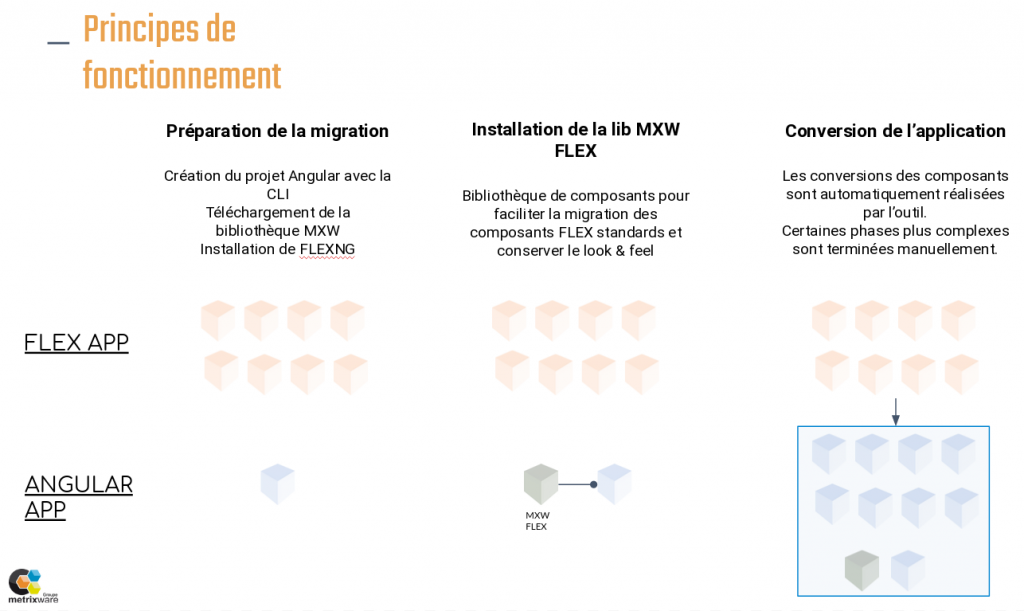 FlexNG tool capabilities: code analysis, MXML conversion, TypeScript generation
Results: Transforming Enterprise Migration Economics
Quantified Outcomes
Project Scale
- ✅ 500 screens successfully migrated from Flex to Angular
- ✅ 1 million lines of code (frontend + backend) modernized
- ✅ 18-month timeline completed despite COVID-19 pandemic challenges
- ✅ 4-person team (1 senior architect + 2 junior developers + 1 PM)
Migration Efficiency
- ✅ 80% automation of screen conversion to Angular components
- ✅ 20% manual refinement (event handling, triggers) - could be accelerated with GenAI today
- ✅ Auto-generated UI library of common widgets accelerating development
- ✅ BlazerDS to REST migration for frontend-backend communication
- ✅ Zero downtime during incremental component migration
Technical Improvements
- ✅ Backend modernization: Java 6 → Java 11 upgrade
- ✅ Framework update: Legacy Spring → Latest Spring Framework
- ✅ 3x performance improvement (lightweight Angular vs. Flash runtime)
- ✅ 100% browser compatibility (Chrome, Firefox, Safari, Edge)
- ✅ Mobile-ready responsive applications
Business Benefits
- ✅ Eliminated security risks from deprecated Flash/Flex
- ✅ Future-proof platform with active Angular ecosystem
- ✅ Easier talent acquisition for modern JavaScript/TypeScript developers
- ✅ Innovation enablement through modern framework capabilities
Client Impact: Metrixware’s Success
End Client: Major French Defense Contractor The successful migration of a mission-critical 500-screen application for a large French military equipment company demonstrated FlexNG’s capability at enterprise scale during the COVID-19 pandemic.
Metrixware Business Impact (20-30 employee consulting firm)
After the successful defense sector project, Metrixware integrated FlexNG into their Rapid technology offering:
- Won 2 additional projects: Proven success led to immediate new business
- Market expansion: Approached multiple Flex-using organizations
- Competitive differentiation: First automated Flex migration solution in market
- Pandemic resilience: Completed complex 18-month migration remotely during COVID-19
- Repeatable methodology: Established proven process for future Flex migrations
- Team scalability: Junior developers productive thanks to auto-generated UI library
Key Takeaways from This Legacy Modernization Project
1. Automation Is Key to Migration Success
Our 80% automation rate on a 1-million-line codebase proved automated tools are essential. The remaining 20% (event handling, triggers) represents areas where modern GenAI could provide further automation.
Real-world proof: 500 screens migrated in 18 months with 4-person team (including 2 juniors) vs. estimated 3-4 years for manual rewrite with 10+ senior developers.
2. Component Library Strategy Multiplies Efficiency
Analyzing all 500 screens upfront to identify common patterns was crucial:
- Auto-generated UI library eliminated repetitive development
- Junior developers productive immediately with standardized components
- Consistency across application improved automatically
- 3-4x acceleration on later screens as library matured
3. Pandemic-Proof Architecture Decisions
The COVID-19 pandemic hit mid-project, but our choices enabled success:
- Component-based migration allowed parallel remote work
- Automated tooling reduced need for constant coordination
- Clear separation between backend and frontend teams
- Incremental delivery maintained project momentum
Facing Adobe Flex End-of-Life? Let’s Talk.
If your organization is struggling with:
- Adobe Flex or Flash application modernization
- Legacy technology end-of-life challenges
- Technical debt in mission-critical applications
- Need for automated migration tools
We can help.
Schedule a free consultation to discuss your migration needs, or learn more about our FinOps services and portfolio of successful migrations.
Related Services
- View Our Portfolio of Successful Migrations
- Browse Case Studies
- FinOps & Cloud Cost Optimization
- Schedule a Migration Assessment
About This Project:
- Client: Metrixware (metrixware.com)
- Year: 2020
- Technologies: Adobe Flex, ActionScript 3, MXML, Angular 8+, TypeScript, HTML5, CSS3
- Services: Custom tool development, migration automation, consulting